Showing posts with label Ancient Britain. Show all posts
Showing posts with label Ancient Britain. Show all posts
Tuesday, January 6, 2015
Greek, Roman, and British Mythology
Greek, Roman, and British cultures were very much predominant in ancient Europe. The myths and tales of each of these countries are historically integrated in each other, in fact, it is difficult for historians to accurately pinpoint what Roman mythology was like before it was introduced to Greek mythology because of its immediate influence on the former. Most aspects of Roman mythology were not recorded, but instead kept in the memories of people who knew the stories well. This made it very easy for Roman mythology to change and distort as the Roman citizens heard of other myths. Because of this cultural integration, Greek and Roman myths became increasingly similar as the two cultures became more and more involved with each other.
Roman mythology often centered around the deification of significant Roman figures, such as emperors and heroes of war. The stories themselves often romanticize the history of Rome, and the beasts explained in such stories often appeared physically as hybrids of two or more animals. For example, the Roman harpy was a bird with the head and chest of a woman and was believed to control the winds. Ancient Greek literature also uses this animal hybridization to create creatures, but Greek monsters are built less around a story and more around an inexplicable phenomenon that needs explaining.
British mythology is more human-centric. Most of the monsters out of British mythology are humanoid in form or based off of man's best friend, the dog. Humanoid monsters, such as the green man, a man with foliage sprouting out of his face who is largely responsible for springtime, mermaids, people with fish tails that lure sailors to their doom, and selkies, seal people, seemed to have the same purpose as Greek and Roman monsters did- to explain the unexplainable or to add a sense of mystery and fear to a dangerous place. Dog-based monsters, such as Faerie dogs, which are banshee-like barking omens of death that live in the dark parts of the forest.
For my product, I will be creating a new mythological creature by taking reference and influence from these three cultures. I will begin with a phenomenon, like the Greeks, use the hybrid characteristic coined by the Romans, and the human base that the British were fond of.
I began with the question of deaths in the desert. Ancient peoples did not know much about dehydration, so I've created a beast that roams the desert in packs and picks off unprepared travelers. The species is a centaur with a tiger's body. Possible additions include tribal head tattoos, small wings behind ears, and pincer-like sharp teeth.
(Progress: I have tons of concept sketches but no working scanner at the moment, I will upload the final product and its progress as it will be done digitally! References used)
Works Cited
Hargraves, Richard, Elaine Kenzel, and Miami, FL. Dade County Public Schools. Greek And Roman Mythology: English, Mythology. n.p.: 1971. ERIC. Web. 6 Jan. 2015.
Hayman, Richard. "Ballad Of The Green Man." History Today 60.4 (2010): 37-44. Academic Search Elite. Print. 30 Dec, 2014
Morford, Mark P.O. "Classical Mythology, 8th Edition," 2007. Web. 30 Dec, 2014
"Roman Mythology." Funk & Wagnalls New World Encyclopedia (2014): 1p. 1. Funk & Wagnalls New World Encyclopedia. Print. 29 Dec, 2014.

Sunday, December 21, 2014
The Roman Conquest of Britain
 In 43 CE, the most formidable army in Europe, the Romans, descended in Britain for conquest. This is long after the attempted seizure of the land by Julius Caesar, who only captured part of Britain to establish trade and tribute. What should have been a sweep of slaughter against untrained and hardly prepared group of civilians turned into a long, hard war. The superpower vs. civilian army was analogous to the revolutionary war, with the only advantage of one side being their knowledge of the land.
Although the British were divided into many groups, Celts, Picts, Belgae, etc., many found unification to retaliate against the Roman invasion. As the island had been subjugated under Rome for 100 years, always paying tribute in fear of conquest, Emperor Claudius expected little resistance, and required a much larger military operation than expected. Claudius brought an army of 40,000 foot soldiers and cavalry, as he acknowledged their possible power. Some tribes immediately surrendered to the Romans upon seeing the fighting force, such as some Belgian tribes. Others put up a fight for many years, the Picts for example performed raids of Hadrian's wall in the north for decades to come. The south was the easiest part to capture, as many surrendered and there was little resistance. As the Roman army moved north, however, they struggled to push through the defense Caractacus had made by unifying many tribes. Along with having to defeat Caractacus and his Welsh army, the Celts lived in mid-England, and were very difficult to beat. The Celts were nomadic groups, led by their Chieftains and druids, their religious leaders. They fought nakedly and viciously, using the environment they knew so well to their advantage. To defeat them, the Romans used night raids to destroy their camps while they were asleep drunk. To deal with Caractacus and his army, the Romans merely fought them like they would anyone else, and won with their military dominance in experience, numbers, and weaponry. It became clear as the Romans continued north that their conquest would not be stopped, as any town or small rebellion could be easily destroyed, due to the power of Rome and Britain’s lack of unification.
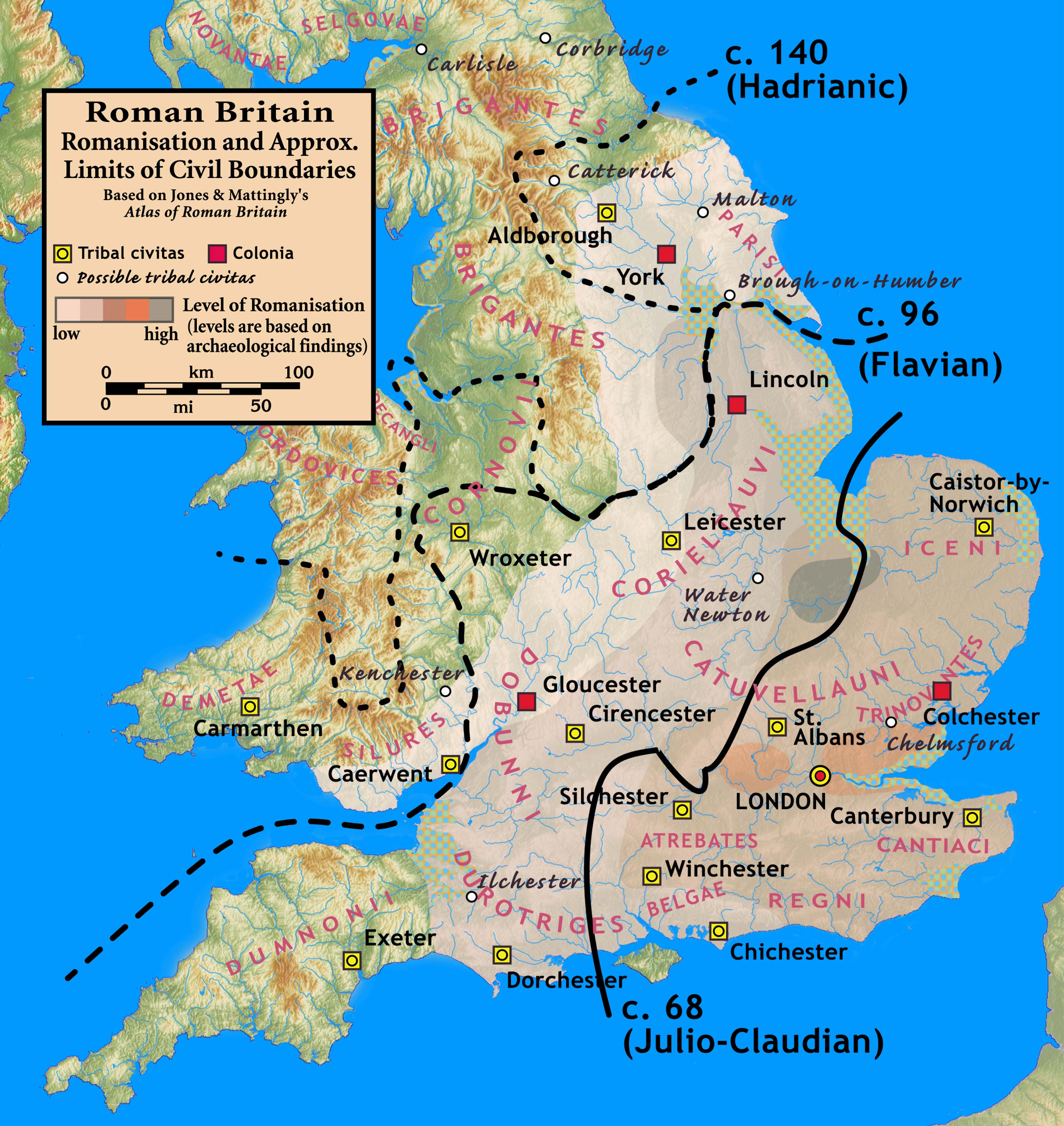
But what if Britain was unified, had an army with some experience, and an ally such as Gaul (before it was taken by Rome), and tried to attack Rome? Around 50 BCE, Julius Caesar was invading Gaul, which had received some help from various southern tribes. In the early stages of the invasion surprise assistance from a unified Britain may have crushed the Roman army, along with Caesar, and created a turnaround that could lead to a great hit to the Republic, as territories joined the revolt and fought back. I created a map that outlines would could have happened if the British invaded Rome, found here.
Works Cited
Deary, Terry. Rotten Romans. New York: Scholastic, 1994. Print.
Hill, Stephen, and Stanley Ireland. Roman Britain. London: Bristol Classical Press, 1996. Print.
Olwson, Donald W., and Russell L. Doescher. "Caesar's Invasion Of Britain." Sky & Telescope . 116.2 (2008): 18. MasterFILE Premier. Web. 11 Dec. 2014.
Roman Britain. Pitkin Guides. Print.
Roman Invasion And Conquest Of Britain B.C. 55 - A.D. 79." Great Events By Famous
Historians, Vol. 2 (2006): 166-172. Literary Reference Center. Web. 11 Dec. 2014.
Subscribe to:
Posts (Atom)