Monday, December 22, 2014

Roman Medicine


When looking for a topic, I chose Roman Medicine. This topic interested me because I was really curious how people in ancient times would be able to handle sickness and disease. 
Medicine is a huge and essential part of our lives that allows us to cure illness and prevent disease. Over the years there have been countless breakthroughs and discoveries. With these, medicine has come an extremely long way from ancient times. But what would happen if we, today in 2015, were only educated as much as the Romans were about their health. If this were true, people with something as simple as a cold could be at risk of death. This is because the Romans were extremely under-educated when it came to medicine.
They had very little amounts of medicine, but would usually just use prevention to keep them from getting sick. Romans were under the impression that a healthy mind would bring them a healthy body. This not only made them oblivious to all the dangers of the diseases they had, but also prevented them from coming up with cures. If we were only as educated as the Romans were then we would suffer greatly because there were no roman doctors. The head of each household was in charge of the well being of his family and would often use herbal cures to treat his household. It wasn't until the ancient Greeks came along that doctors were introduced. When the roman empire expanded into Greece, the Greeks had a huge influence on the growth of Roman medicine. Although the Romans refused to copy Greek idea’s, they would improve them and turn them into their own. 

There were many negative things about roman medicine, but the Romans did have a few beneficial things that they did which helped them. One of those things was the bone lever (Surgical Instruments). The bone lever was invented by the Romans to take a fractured or broken bone and hold it in the right place. The Romans also had the bone forceps which allowed the Romans to open someones skull and take out tumors in the brain. This contraption was known as one of the most advanced tool the Romans had.

Since Romans believed that a healthy mind led to a healthy body they had many superstitions. One of them was that where they lived effected how healthy they were. (Medical News Today). They would try to live in places that were close to fresh water and also places that were out of the way of pollution or anything else bad. Based on the techniques and knowledge Romans had, if we had the same medical advances and techniques life for us would be extremely different, and the survival rate for any illness would be much lower. People with cancer and other diseases would have absolutely no chance. The breakthroughs and discoveries in medicine have been extremely necessary, because if we only knew as much as the Romans did, life would be much much harder.

final product:

sources:
"Medicine in Ancient Rome." Medicine in Ancient Rome. N.p., 12 Dec. 2000. Web. 21 Dec. 2014.

Medical News Today. MediLexicon International, 14 May 2008. Web. 21 Dec. 2014.

"Roman Medicine." Roman Medicine. N.p., 17 Feb. 2002. Web. 21 Dec. 2014.

"Surgical Instruments from Ancient Rome - Ancient Roman Surgical Instruments." Ancient Roman Surgical Instruments. N.p., 23 Feb. 2012. Web. 21 Dec. 2014.


Sunday, December 21, 2014

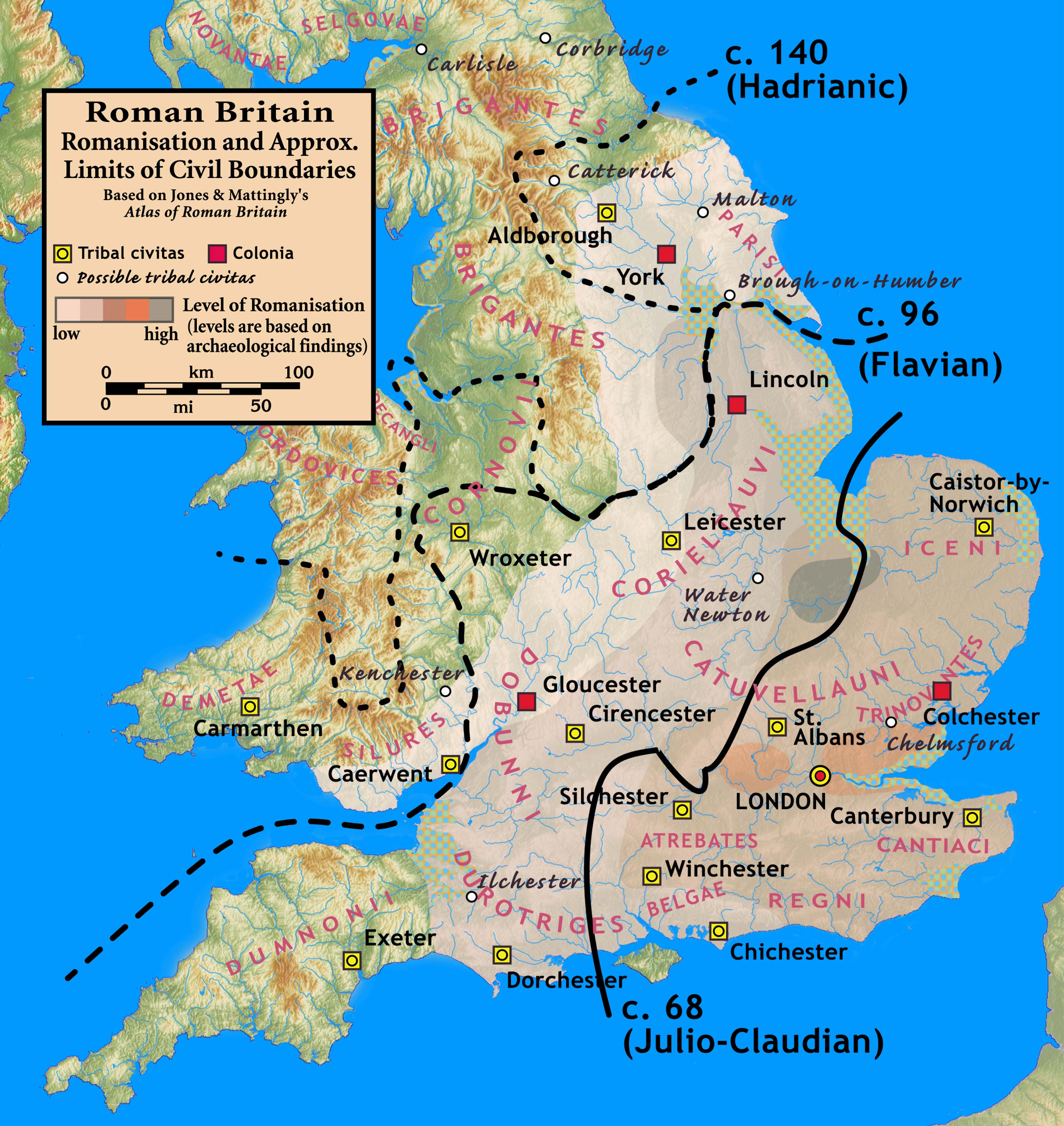
The Roman Conquest of Britain


      In 43 CE, the most formidable army in Europe, the Romans, descended in Britain for conquest. This is long after the attempted seizure of the land by Julius Caesar, who only captured part of Britain to establish trade and tribute. What should have been a sweep of slaughter against untrained and hardly prepared group of civilians turned into a long, hard war. The superpower vs. civilian army was analogous to the revolutionary war, with the only advantage of one side being their knowledge of the land.

       Although the British were divided into many groups, Celts, Picts, Belgae, etc., many found unification to retaliate against the Roman invasion. As the island had been subjugated under Rome for 100 years, always paying tribute in fear of conquest, Emperor Claudius expected little resistance, and required a much larger military operation than expected. Claudius brought an army of 40,000 foot soldiers and cavalry, as he acknowledged their possible power. Some tribes immediately surrendered to the Romans upon seeing the fighting force, such as some Belgian tribes. Others put up a fight for many years, the Picts for example performed raids of Hadrian's wall in the north for decades to come. The south was the easiest part to capture, as many surrendered and there was little resistance. As the Roman army moved north, however, they struggled to push through the defense Caractacus had made by unifying many tribes. Along with having to defeat Caractacus and his Welsh army, the Celts lived in mid-England, and were very difficult to beat. The Celts were nomadic groups, led by their Chieftains and druids, their religious leaders. They fought nakedly and viciously, using the environment they knew so well to their advantage. To defeat them, the Romans used night raids to destroy their camps while they were asleep drunk. To deal with Caractacus and his army, the Romans merely fought them like they would anyone else, and won with their military dominance in experience, numbers, and weaponry. It became clear as the Romans continued north that their conquest would not be stopped, as any town or small rebellion could be easily destroyed, due to the power of Rome and Britain’s lack of unification.


     But what if Britain was unified, had an army with some experience, and an ally such as Gaul (before it was taken by Rome), and tried to attack Rome? Around 50 BCE, Julius Caesar was invading Gaul, which had received some help from various southern tribes. In the early stages of the invasion surprise assistance from a unified Britain may have crushed the Roman army, along with Caesar, and created a turnaround that could lead to a great hit to the Republic, as territories joined the revolt and fought back. I created a map that outlines would could have happened if the British invaded Rome, found here.


Works Cited


Deary, Terry. Rotten Romans. New York: Scholastic, 1994. Print.

Hill, Stephen, and Stanley Ireland. Roman Britain. London: Bristol Classical Press, 1996. Print.

Olwson, Donald W., and Russell L. Doescher. "Caesar's Invasion Of Britain." Sky & Telescope . 116.2    (2008): 18. MasterFILE Premier. Web. 11 Dec. 2014.

Roman Britain. Pitkin Guides. Print.

Roman Invasion And Conquest Of Britain B.C. 55 - A.D. 79." Great Events By Famous

Historians, Vol. 2 (2006): 166-172. Literary Reference Center. Web. 11 Dec. 2014.

Glassblowing: Past to Present


By: Emeline

After learning briefly about glassblowing in class, and then going on the field trip to an artist’s shop, I was intrigued and inspired to do more research into the origins of glassblowing, and its future. Also, I have been to Murano, Italy, where one of the biggest industries of glassblowing is, and it was so interesting to me. I found glassblowing to have a broad and plentiful amount of information and related topics. Extensive research shows just how far glassblowing has come.

Greek and Roman Mythology and their Modern Equivalents

Since Greek and Roman mythology has always intrigued me, I decided it would make a great topic for this project. The current chapter (Chp. 17 + 18) is set in Alexandria, which has temples to many gods and goddesses. Although some in the book are Egyptian, I will be focusing mainly on Roman gods (and their Greek equivalents). I decided to learn about the ancient gods, and then make up my own gods for modern life. Some of the ancient gods were:

  • Zeus/Jupiter; King of the Gods. Married to Hera/Juno.
  • Hera/Juno; Queen of the Gods. Married to Zeus/Jupiter.
  • Poseidon/Neptune; God of the Seas.
  • Hades/Pluto; God of the Dead.
  • Ares/Mars; God of War.
  • Athena/Minerva; Goddess of wisdom and strategy. 
  • Artemis/Diana; Goddess of the hunt, girls, and the moon. Twin to Apollo.
  • Apollo; God of music, archery,light, truth, the sun. Twin to Artemis/Diana.
  • Hermes/Mercury; God of messengers and thieves.
  • Aphrodite/Venus; Goddess of love and beauty.

You can see many of these names in the modern world, for example the minor god Nike/Victoria who is the god of victory is used for the athletic brand Nike. Venus, the goddess of love, is an offshoot of the razor brand Gillette. From this point, I felt like it would be interesting to try to make my own version of these gods for the modern world. 
  • Twitterus; Goddess of Social Media. Her head is that of a bird, and always carries a smartphone in her hand. She can be characterized as being the most social of the gods, always coming down from Olympus (otherwise known as the Caribbean) to take "wicked awesome selfies dude."
  • Electro; God of electricity. His head is covered in bright blond hair that crackles with electricity. Although he is much like Zeus/Jupiter, he is not the god of the sky, only of electricity.
  • Mobius; God of Transportation. Whether it is a train, a car, or a plane, Mobius has it down. He is known as the modern day Hephaestus/Vulcan (who was the god of the forges). He always has a wrench in his hand, and all of his clothes are stained with grease.
  • Computus; God of Computers. Although Computus is a god, nobody actually can confirm his existence, since he has never been seen to emerge from the dim light of his computer screen.
  • Medicus; God of Medicine. Medicus travels around the world saving lives, whether it be in a hospital or at home. He always wears a pair of spotless scrubs, and a face mask. He is known to be a bit of a germaphobe at times.
These gods were based off of what I believe to be some of the most important things in modern day life. I learned that many of the gods in ancient mythology were based off of tasks done around the house, or in the country. Since many of the things stated above have impacted our lives greatly, this is what helped me create them.

Works Cited
Mehta-Jones, Shilpa. "Religion and Beliefs." Religion and Beliefs. N.p., 2005. Web. 21 Dec. 2014.
"Roman and European Mythologies." Roman and European Mythologies. N.p., n.d. Web. 21 Dec. 2014.

Roman Conquest of Britain

Jason Mirandou

I decided to make my common task on the Roman Conquest of Britain. I was very intrigued by this topic.

Glass Making in Ancient Rome


I decided to research the history of Glass Making because Glass making was a form of art in Rome and Egypt. Glass Making is one of Alexandria's oldest and most successful industries. The earliest Egyptian glass vessels date from about 1500 B.C and glass continued to be made in Egypt through the period of the Pharaohs, the Ptolemaic Kings and the Roman conquest and occupation. In my research, I have learned that Glass is made of sand and plant ash. Glass making is important to Roman and Egyptian life because it is one of the most successful industries of the time.

How to deal with deaths of leaders in ancient times.


How to Deal with Deaths of Leaders in Ancient Times

I researched the pyramids of Giza and the Mausoleum of Augustus. I tried to compare and contrast them in my product where I 'stepped in the shoes of' both Augustus and King Khufu in each others burial place. I learned a lot about the construction theory of a Greek philosopher that had a proven way to make the pyramids. It involved using water and floating several tons of rock up hill using a system of gates that use pressure to bring the blocks up the tube. They were then laid out in a base built up from there. Mining the blocks was probably the hardest job though. The master cutters cut and leveled blocks in water to perfect the rough cuts made with stone tools. The inside of the pyramids were also extremely interesting. The corridors, vents and rooms were all nearly perfect in design only off by a percent or two. This was a great feat as there was no such thing as a level or any power tools (1). The pyramids also had a spiritual use. They were supposed to reflect the light to the gods so that the mummy inside could use the rays of light to help him ascend to the gods, particularly, the sun god, Ra. Helping him to this place were also a number of priests, close friends, and a great number of luxuries. The luxuries were to provide him comfort during his journey to the gods (2).

Before limestone, or any type of cut stone was used, mud bricks were used. They were sturdy but nothing in comparison to the limestone and sandstone. The first pyramid made with these blocks was a large step pyramid. Something like what we might see in Giza today. This of course was very different in ancient times as the lateral faces were smooth and shiny with white limestone (3)

The mausoleum of Augustus in currently in Rome where it is a hot spot of many tourists.

The mausoleum did not just hold Augustus. It also held his descendants except the daughter of Augustus who disgraced her family. A large portion of the building was made of white marble but a lot has been stripped away due to erosion over almost 2000 years. The site can be visited today in Rome but it cannot be entered due to robberies and so there is no graffiti. When built, it must have looked something like this.


As you can see the building has a number of tiers and many flourishes and shrubbery. On either side of the entrance were two large columns. It was surrounded by a few gardens that held some of the most diverse of that in Rome. Atop the building was a large statue of Augustus Caesar holding what looks to be a spear.

In comparison to Augustus' mausoleum, the pyramids were big, burial places of important people, and are now important landmarks.
In contrast to the pyramids, the Mausoleum of Augustus is a bit smaller, rounded, surrounded by gardens, and in Rome while the Pyramids are larger, more technical, near a city and in the desert.

My final product can be found here


Building the Pyramids of Egypt ...a Detailed Step by Step Guide. Dir. Pyramidsreallybuilt. Youtube. Youtube, n.d. Web. 20 Dec. 2014.

History.com Staff. "Egyptian Pyramids." History.com. A&E Television Networks, n.d. Web. 18 Dec. 2014

Doyle, Noreen. "EGYPT's Master Builders." Calliope 24.3 (2013): 12. MasterFILE Premier. Web. 22 Dec. 2014.

"Mausoleum of Augustus." Mausoleum of Augustus. N.p., n.d. Web. 18 Dec. 2014..

Doyle, Noreen. "EGYPT's Master Builders." Calliope 24.3 (2013): 12. MasterFILE Premier. Web. 21 Dec. 2014.